A Hill of Water
How to get inside your heart
Nutmeg
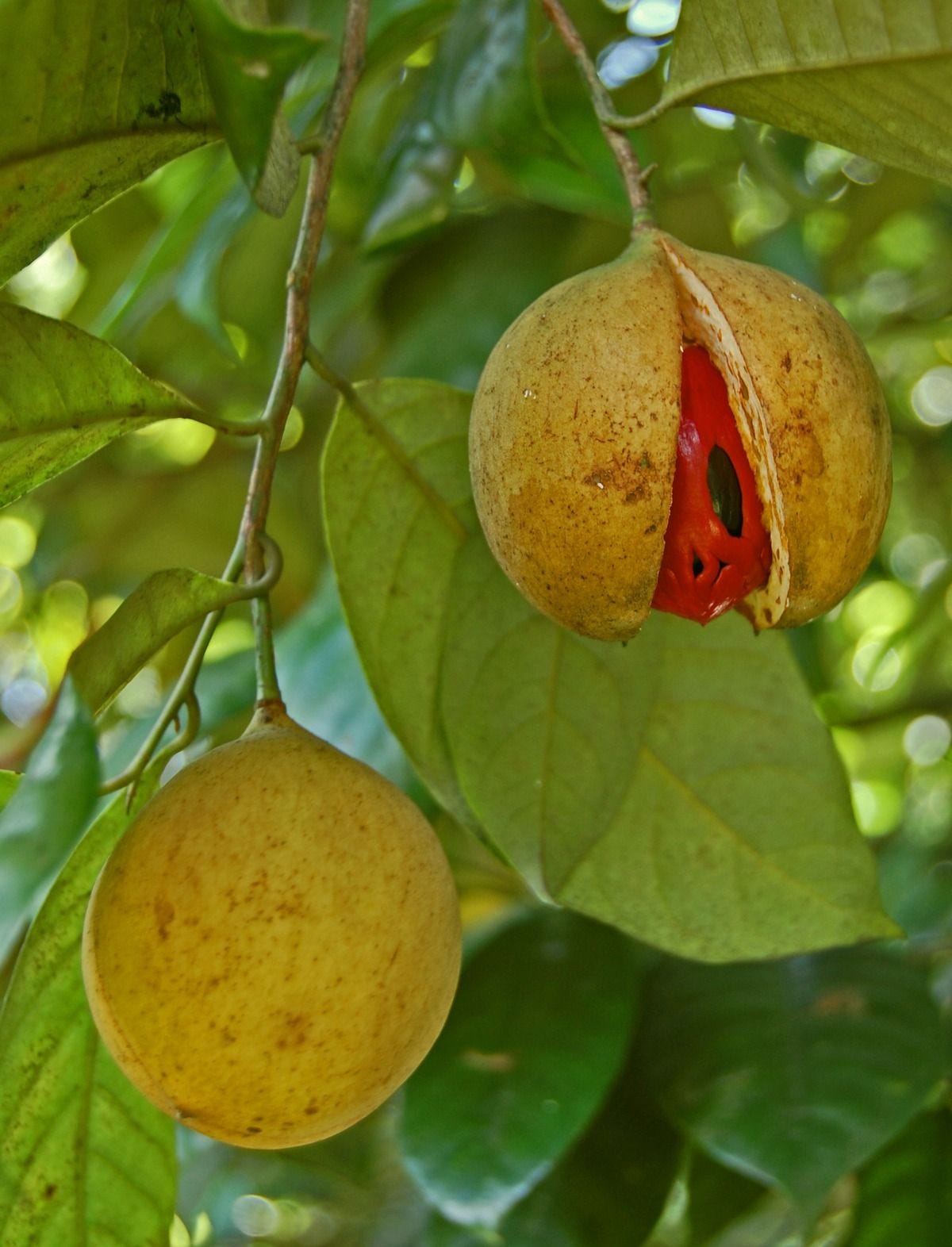
It was when Lisa was visiting a school in Sri Lanka in the late 1960s that she first saw a nutmeg tree and felt its pull. Years later, she would plant a seedling not far from her house on the organic tree farm she was developing as a lesbian separatist rainforest commune in a wilder corner of Hawaii’s Big Island. It did grow and sometimes flowered, and after about 10 years, its first nutmeg was born. Now the tree is full of nutmegs hanging like speckled pale yellow baby pears. I have been visiting this nutmeg tree for years now. In the sun they grow and the hull splits at the bottom where you can see the slightly alien red orange matrix of the mace, and you know that it is ready to pick. Peel off the lava flow of the mace and dry it separately. Under this is a shell that hardens as it dries for a few days in a bowl in a propane oven warmed only by the standby pilot light heat. When you can hear a rattle, the nutmeat inside is ready. After cracking open this inner shell you might grate the slowly roasted nutmeg over a coconut milk rice pudding or just hold it in your shirt pocket so you can become that smell. I always imagine the spice in Dune to be a nutmeg. A buried, intensified, nearly poison in its purity compacted and breathing at the very meeting of sky and dirt dreaming.

A Hill of Water
In the Hawaiian language, the word for heart is sometimes translated as “place of water.” Or some people say that. Translation is slippery. The Hawaiian word for heart is puʻuwai — pu’u meaning hill or mound and wai meaning water which could be simply read: lump of water. This doesn’t seem like the right mood for a Valentine or love note but it kind of makes sense. Historically, Hawaiians more often recognized the nāʻau (intestines or gut) as the primary seat of emotions and instinct and pu’u is from the proto-oceanic meaning not just a hill but any lump or protuberance. So some of the way English speakers talk about hearts don’t quite cross over. Then again wai is not just water but specifically fresh water which on an island in the middle of salt water is an extremely precious (and shared!) resource. Despite, or maybe because of, the circuitous meanderings of language, I do feel that my heart is a bit Hawaiian: a watery centre inside an already watery self.
My Name
Years ago on a beautiful spring night I was told what my name meant. I have always felt kind of ho hum about my name and hadn’t gone beyond looking up Jason, his argonauts and the Golden Fleece. The evening of readings was over and The Poet was enjoying a cigarette on the back steps of the concert hall where he had a couple of hours earlier won the international category for the largest poetry prize in the world. I was unlocking my bike on my way home and I told him how moved I was to hear his poetry spoken in Arabic first and then translated. Everyone was. It sounded like the oldest song in the world. He asked me my name. I told him and then gave me a significant look. He told me that in his language this name is very special. It is pronounced Hasan, he said, and it means heart of the heart. I hopped onto my bike and glided back home through the night.
I knew even as it was happening that I would hold that night with the poet on the steps at the back stage door for the rest of my life, but I never dreamed that I would find myself a few years later actually swimming upstream and into the heart of my heart.

A Procedure for Going Deeper
They wheeled me into the white room. It had high ceilings and a viewing floor and a screen that looked like a huge sports bar television with my name and all my details on it. They told me to stay as still as possible. They kept calling it a procedure rather than a heart operation, but the room and equipment and doctors and technicians gave it the aura of a space flight. I had a hole in my heart called a PFO. Before birth, the hole is a passageway for the a mother to share oxygenated blood. Usually once a baby is breathing oxygen through its lungs, the hole closes up naturally. My PFO was big and there was a smaller hole beside it making blood flow in the wrong direction. Fixing it was medically straightforward. For me it was a swim into my own centre.

Because I was not allowed to move, all I had to look at was that screen. They painted my leg orange and threaded something into it and told me to hold still. I did not notice my leg or my outside body or all the technicians and doctors, the big swivelling camera wrapped in a plastic bag, the lights and glossy floor, the way I was stopped in the awkwardness of that. All of it faded into the background. I was watching. I was the camera. Pulsing like an ultrasound but clearer. A moving X-ray travelling up some sort of tube where you can see the spine. All is liquid like one of those games as a kid where you push two buttons to make jets of water in water to urge plastic rings onto a dolphin’s snout. How slow everything was in there. A soft and serious surgeon voice narrates our voyage: “Entering the femoral vein”.

We are underwater now, a tendril appears shimmering white in the inverted X-ray world delicate like a baby seahorse tail or stop-motion shoot of a plant reaching out to something to cling to, waving slightly in the current. A fluttering of glitter at the edges. Slowed time. And another view closer now night vision ribs filling the screen. Pulsing. And I can feel it into my arm and towards my heart maybe this one is an ultrasound camera because we are close in now and I can see the heart itself. I mean my heart. Me. I am all water in there. I am underwater. The heart is no machine. It does not pump or beat. It doesn’t even burble like a stream. It undulates. A corral ballet. A sting-ray slowed power of the jellyfish, the twilight dream of mercury. It’s just so quiet inside me. And now the wire moves from one chamber to another it enters the tiny gap that should not be there.
We, as camera, zoom in closer, a slightly thicker wire curves its way through. Like trying to clasp something stuck down a drain, you can feel the wire trying to do as the surgeon wants it to do, and occasionally the silver thread hits the side and there is a little cloud of smoke which must be blood inside of blood, I think, but I do not quite understand. Inky. And then finally, they have thread the needle, wet in wet, and a tiny bead moves its way up through my legs through my vein into the first chamber and tucks into the next, and there unfurls into a tiny disk little alien thing. And another opening up, another tiny disk, a butterfly a wing on each side of hole making a plug, a block. Closing that part that once let me breathe inside my mother. The procedure is complete. My insides will grow over the plug they put in. All is back to normal. Except now I know my heart is a watery thing. I have swum there.


Water and Air
For my practice in foraging and natural colour the real work of Melissa McGill’s A Lake Story was in my conversations with her and then with the lake and all of its tributaries. I developed a set of possibilities which I brought over the border in big Canadian Tire buckets to share with Melissa at her studio and home in Beacon, New York. The border crossing was iffy. You know: Walter-White-meets-American-Psycho-see-through tarp-large white buckets-upstate-New York-goateed-Trump-loving-border-guards iffy. We spent a very intense few days in extreme heat in Melissa’s studio and backyard developing methods and following chemistry, instincts, and the wisdom of natural dye traditions to fit the colours and materials of the Lake that were available in enough abundance to match the scope of her vision.
Melissa’s husband— a Sam Sheppard-like Texan who manages a photo studio in New York— assisted with a series of gourmet popsicle runs. Our hours were long but eventually I returned home (The Canadian Border was easy) with some of our reformulated colours, detailed notes, and an emerging clarity about how this thing that we knew would work was actually going to work.
I spent a summer in further researches and collecting with a particular interest in buried waterways and the old edges of the lake. The next big push was our colour lab set up in a huge industrial space. It was mad science. DIY engineering. A team dedicated to colour. A kind of factory of dreams. I was at the same time working on a major project with The City of Markham and learning how to fly kites. There were trial runs, and spreadsheets, and meeting with volunteers and learning to roll silk, and a million other details in preparation. Also a big team and the backing of the Bentway and Melissa’s extraordinary leadership all the way through. By the time we got to the performance of A Lake Story I figured my job was mostly done and I could become a spectator of all the beautiful colours I had set in motion with Melissa. At the last minute I thought maybe I should participate as a paddler for at least one the performances, just to see how the colours interacted in the middle of the flotilla.
Of course the minute you set foot in a canoe you become part of a crew, even it it is just one or two other people in the vessel. In this case, our canoe was part of a pod of 10 canoes responsible for a very particular formation. These pods then were part of the entire team of hundreds of canoes and paddlers and silks, all instructed and coordinated by team captains, lead boats, weather trackers, people back on shore organizing, the list goes on and on. The team atmosphere of sporty canoeing folks in matching outfits, hats, and PFDs all assigned numbers and configurations and roles with sometimes early morning practices gave me pause.
The only sport I had ever played was long distance running and tennis and I liked both because I didn’t have to let anyone down or be picked last. I was happy to give a speech about the colours and my reverence for small things becoming big things. I was overjoyed to be such a critical ingredient in a project that was so huge and beautiful and in line with my hopes for the world. And honestly, when Melissa says come join me, you just say yes. But team physical activity? The spirit of teamwork? Not really my thing. Unless. Every day before going out on the water Melissa would give a pep talk. Even now I cringe at the phrase. But that is what it was. Her speeches were a little different every time but always she said:
“You are the heart centre of this project. That’s how this works, from the centre out.”
And as a flag bearer, I felt it. Saw it. Was inside it. My two hands holding the bamboo pole letting the silk take to the wind and become its own kind of water in it.
It is common in Hawaiian to intensify a word by doubling it. So kiko (which means dot) becomes kikokiko meaning freckled. The word for wealth in Hawaiian is waiwai. Double water.
In a week I will return to the Big Island. To the nutmeg tree and the clove tree right across from it. I will see the ripening pink peppercorns, cinnamon bark, pomelos, avocados, macadamia nuts, and tangelos electric with warm sun. I will see Lisa and her tree farm for what is almost certainly the last time. I will return home with a heart full of water.
I love you, all of you.
Jason
What is inside your heart? Do you have a nutmeg story? Island thoughts. I would love your thoughts.


What an utterly beautiful piece of writing. Thank you for sharing it with us.
It would be lovely if your friend Lisa could preserve their tree farm. Just a thought. I loved all of this and especially forgot the ring toss game from my childhood. Thank you for sharing 🤍